Procedural environment
Climate-driven forest and river scatter, built on SideFX Labs Biome and kept natively USD end to end.
 András Turcsán
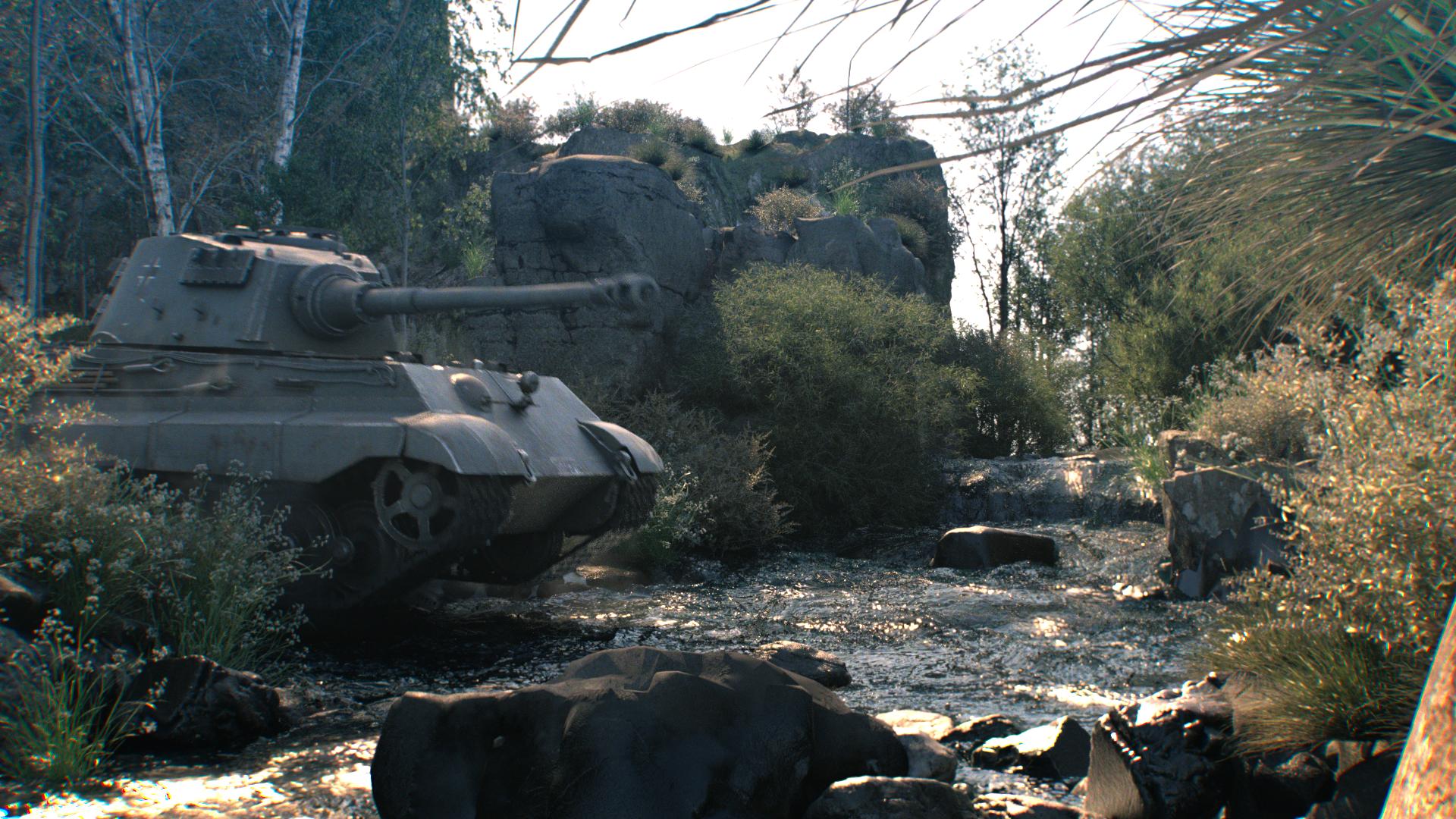
Flagship case study · Ongoing personal R&D
A vehicle, terrain and FX study built as one connected Houdini production system.
Production context
River Crossing places a Tiger II at a shallow forest ford in a Norway-inspired biome: an 8 m-wide stream flanked by climate-accurate woodland, the tank fording the water and coming to rest on the near bank. The shot exists to carry a full production system — vehicle, terrain, vegetation and delivery — not just a single hero simulation.
Two systems built for this shot became its technical spine: a from-scratch, solver-free tank-track rig, and a native-USD vegetation pipeline that keeps a 26-variant plant library fully USD-composed instead of flattened. Both are covered below.
Pipeline at a glance
Climate-driven forest and river scatter, built on SideFX Labs Biome and kept natively USD end to end.
A solver-free, scrub-safe track rig — 99 links, 6 nodes, zero cache dependency, deterministic on any frame.
Dust, water interaction and the firing/recoil system coordinated with the vehicle's own timing.
USD/Solaris assembly through Karma, with vegetation instanced natively rather than flattened per variant.
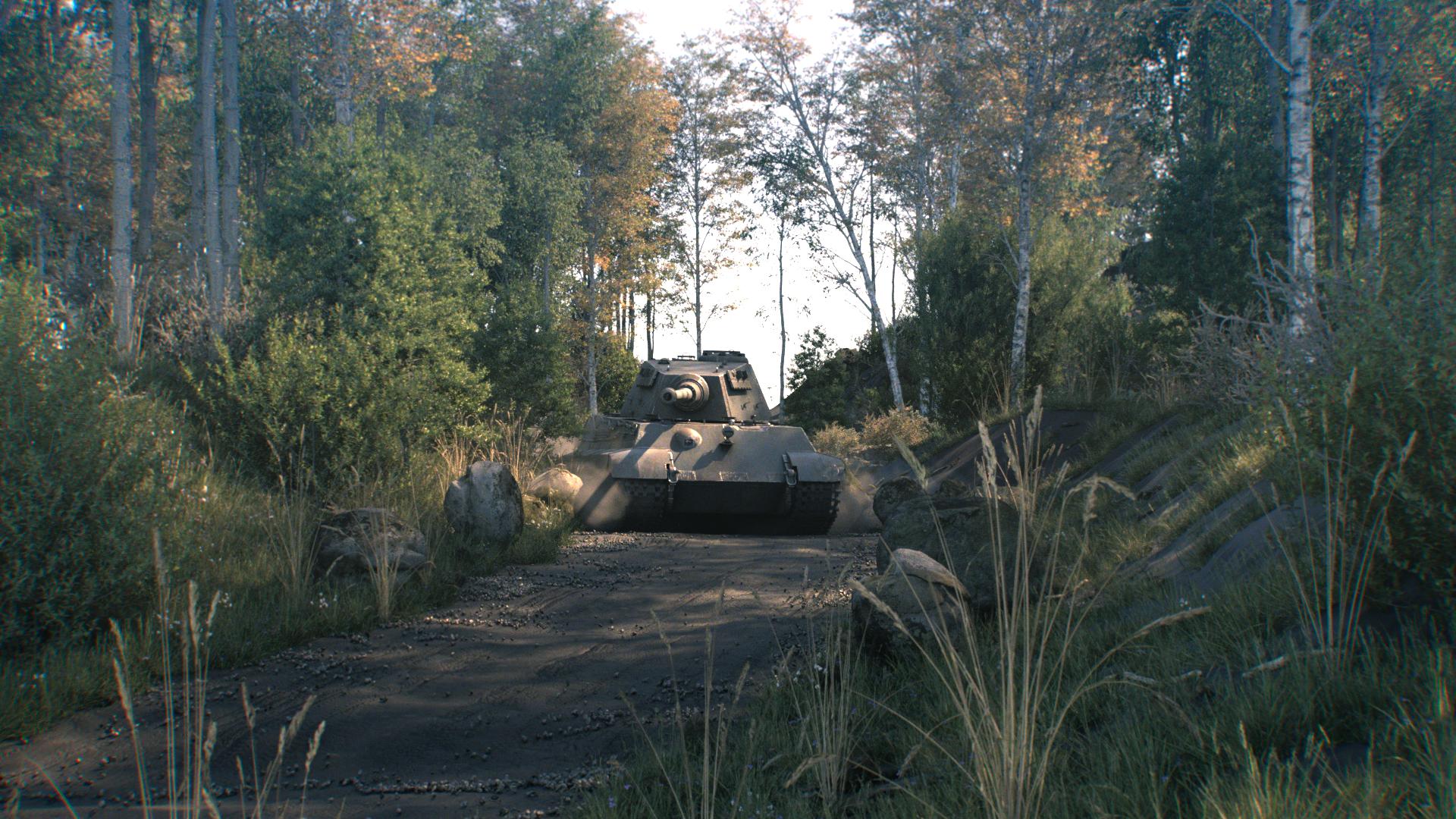
Main approach camera · integrated environment, vehicle and dust study
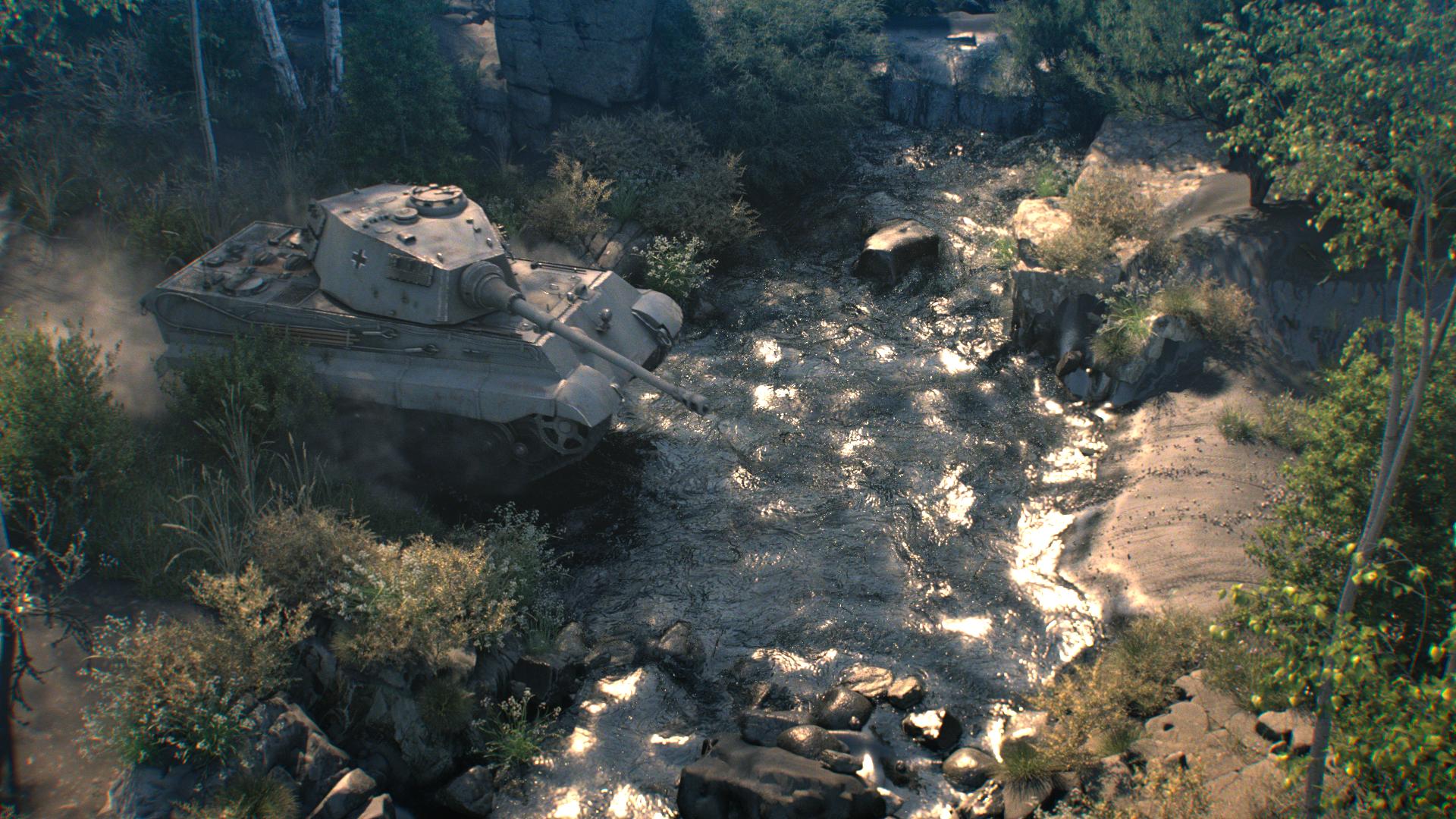
Overhead ford camera · track, dust and water reacting in the same shot
Problem / constraint
A tank fording a stream only reads as one event if track motion, terrain contact, dust and water react in the same rhythm — and if the underlying systems hold up under production conditions: scrubbing, caching, and a plant library too large to hand-place. Two unrelated blockers surfaced here: the classic Solver-SOP track rig breaking under scrub/playback with accumulating phase error, and SideFX Labs' Biome scatter tool failing to resolve USD variant selection across a 26-variant plant library.
System decision
Rather than rebuilding Biome's ecological logic (climate-tolerant species choice, density, collision-radius culling), the fix targeted only the broken link: its SOP-level loader can load USD geometry but can't compose a variant selection, so its point cloud is instead carried into Solaris to drive a native USD PointInstancer, letting real USD composition resolve variants and materials — no HDA fork, no flattened duplicate library to maintain.
Artist-facing evidence
Short clay studies isolate the vehicle system from final lighting and surface detail, keeping the procedural behaviour readable.
Wheel articulation, chassis response and procedural track motion are evaluated together as the vehicle follows the generated terrain.
A coordinated control layer connects barrel recoil, vehicle response and shot timing before downstream muzzle, dust and impact effects are added.
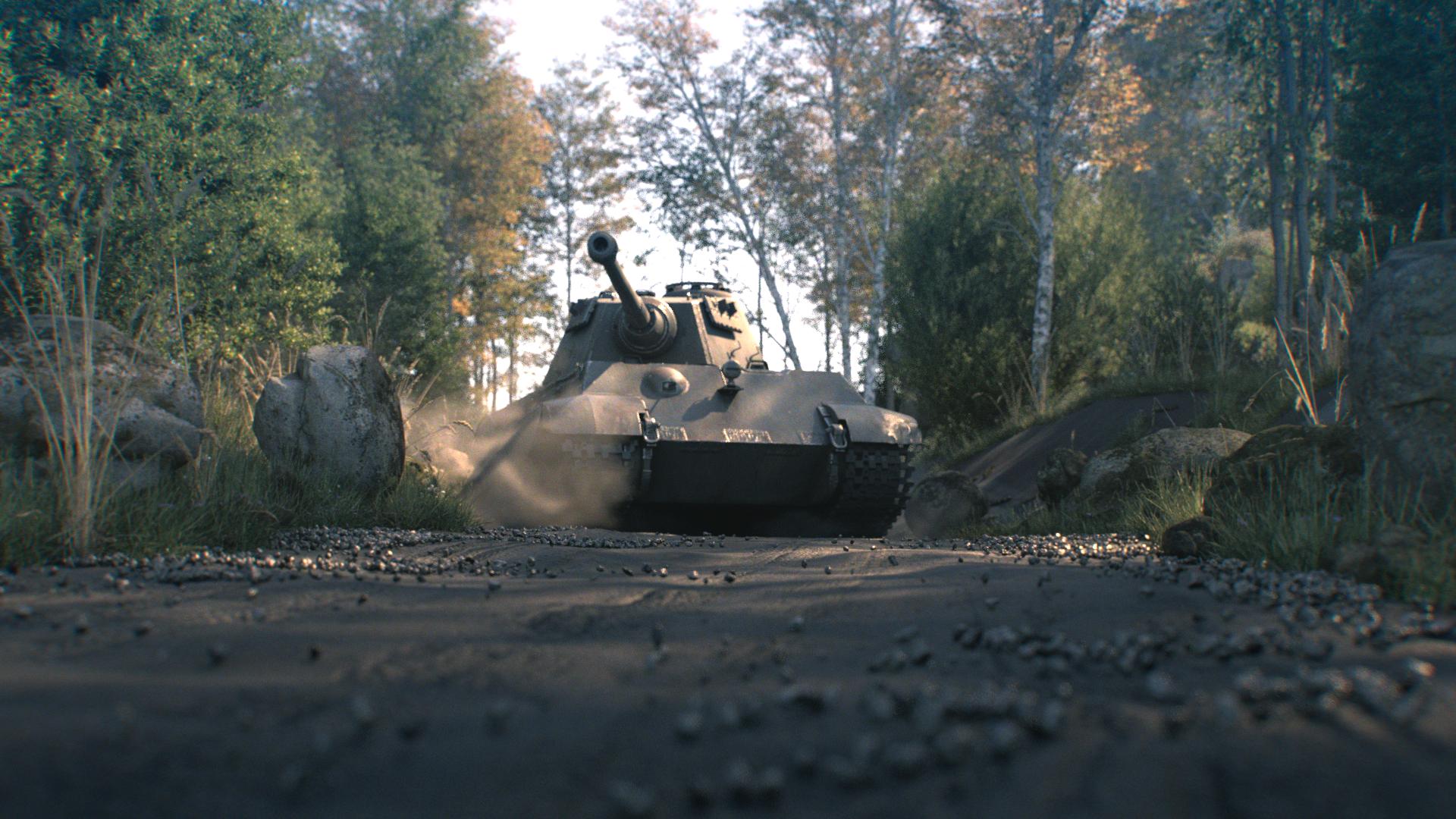
Low approach camera · dust and ground-contact detail
Production impact
The track rig is fully scrub-safe and cache-independent: jumping to any frame gives the same deterministic result, at over 120 fps in the viewport for the whole rig. The vegetation system keeps the plant library in one native-USD source of truth — live variant switching, no duplicated per-variant files — while still getting Biome's climate-aware placement. Both systems outlive this shot: the track logic applies to any animated chain, belt or rope-like rig, and the USD-instancing pattern applies to any large-scale scatter that needs to stay natively USD.
Contribution and credits
Personal R&D project — concept, environment, rigging, simulation, lookdev and render by András Turcsán in Houdini. Plant models from the Maxtree library; vegetation ecology built on SideFX Labs' Biome toolset. The Tiger II vehicle model is a downloaded third-party asset and was not created by András Turcsán.